Views: 1 Author: Site Editor Publish Time: 2026-10-19 Origin: Site
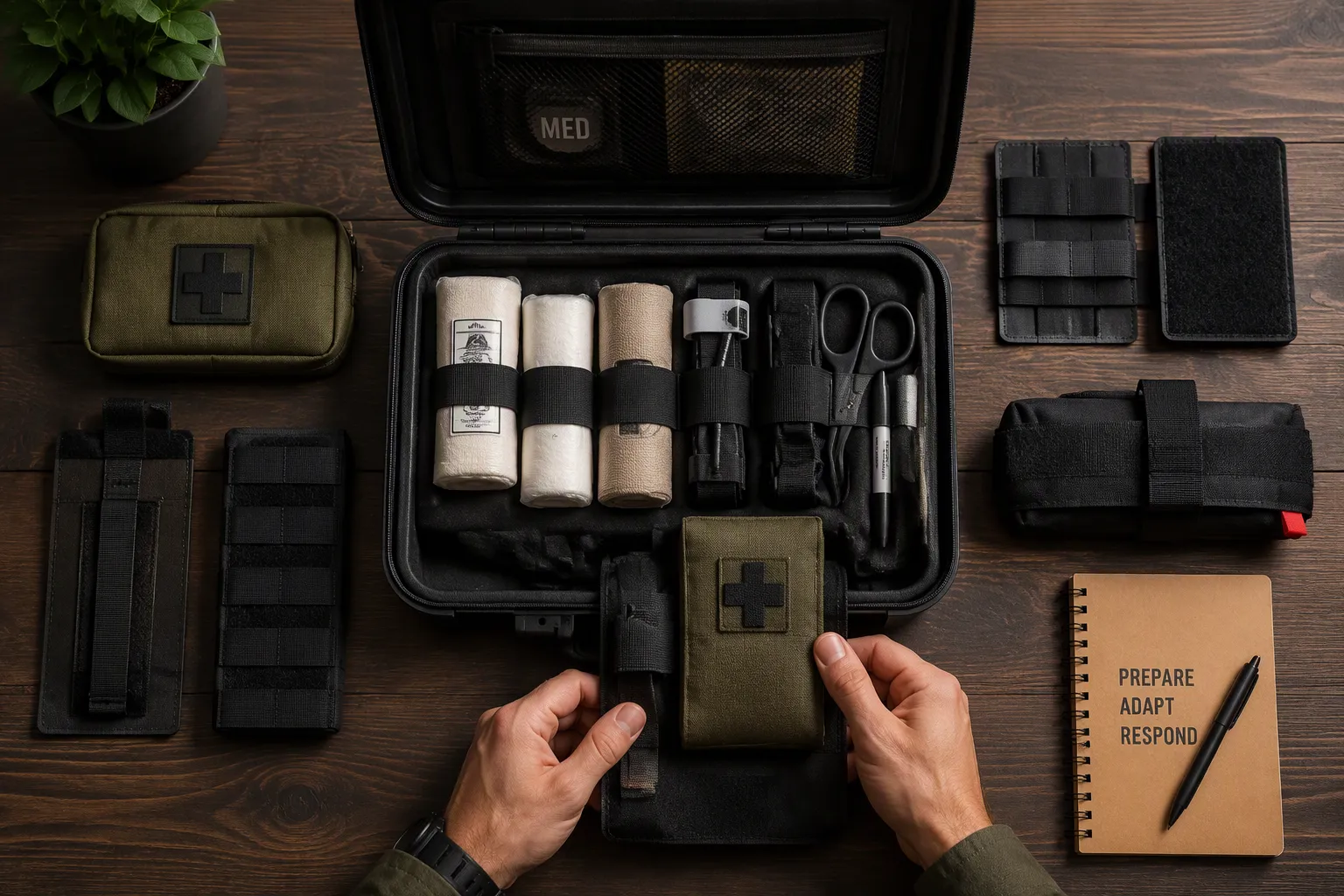
You can safely customize the accessories in your IFAK Army EVA First Aid Kit Customize first aid accessories with confidence. The modular design invites these changes. Three rules remove the fear: keep the core lifesaving items, choose compatible accessories, and test every change before you rely on it. You do not need to be a medic to swap, add, or reorganize gear. Every change is reversible, so a mistake costs you minutes—not safety.
Keep the core lifesaving items in your kit. These include a tourniquet, pressure bandage, hemostatic gauze, and chest seal. Never remove them.
Choose accessories that fit your kit's design. Check size, attachment method, and materials. Test every change before you rely on it.
Customize your kit step by step. Assess your needs, select the right gear, organize for fast access, and practice with your kit. This builds confidence and safety.
The EVA shell forms a rigid, waterproof barrier around your gear. It shields contents from impact, moisture, and dust. You can drop the kit, expose it to rain, or drag it through rough terrain. The shell absorbs the punishment. Your medical supplies stay sterile and functional. This protective layer gives you the freedom to focus on the contents, not the container.
Inside the shell, you find a system of removable inserts and elastic loops. Each compartment holds a specific category of supplies. You can pull out an entire insert, swap its position, or replace it with a different configuration. The hook-and-loop backing secures items firmly yet allows quick removal. This modular architecture means you rearrange the interior without tools or special skills. You simply lift, adjust, and press back into place.
The IFAK Army EVA First Aid Kit Customize first aid accessories approach starts with a simple premise: no two users face identical threats. A soldier in a combat zone needs different supplies than a hiker on a trail. The designers built the kit to accommodate those differences. They left empty space for expansion. They included attachment points for additional pouches. They engineered the layout for rapid reconfiguration. The kit anticipates your evolving needs, not a static checklist. You can customize first aid accessories to match your specific environment, training level, and mission profile. The design rewards thoughtful modification rather than punishing it.
Customization works best when you anchor every change to a few proven principles. These principles protect the kit's core function while giving you room to adapt. Follow them, and your ifak army EVA First Aid Kit Customize first aid accessories efforts stay safe, effective, and mission-ready.
Every IFAK carries a set of items that address immediate threats to life. You must keep these items in place no matter how you rearrange the kit. The core typically includes a tourniquet, a pressure bandage, hemostatic gauze, and a chest seal. These tools stop severe bleeding and manage airway threats. Removing any of them creates a gap you cannot fill later. You can relocate a core item to a more accessible spot. You can add a second tourniquet for redundancy. You cannot remove the original. Treat the core set as a fixed foundation. Build your custom layout around it, not in place of it. This rule alone prevents the most dangerous customization mistake.
Compatibility determines whether your new gear works with the existing kit. Check three things before you add any accessory. First, confirm the physical fit. The item must sit securely in its compartment or loop without forcing the shell closed. Second, verify the attachment method. Hook-and-loop backing, elastic loops, and MOLLE-style webbing each accept specific accessory types. Match the accessory to the attachment point. Third, consider material compatibility. A water-resistant pouch pairs well with the EVA shell's protective design. A porous fabric pouch may trap moisture and compromise sterility. Choose accessories that share the kit's durability standards. This approach keeps your additions functional and your kit intact.
Portability defines a functional IFAK. You carry this kit on your body or in your pack, often during high-stress movement. Excess bulk slows your access and tires you out. Excess weight does the same. Use the following reference to guide your build.
Attribute | Standard IFAK | Small (Compact) IFAK |
|---|---|---|
Size | Bulkier with multiple pockets | Compact, contained in a single pouch |
Weight | 1–2 kg | 200–500 g |
Portability | Restricted | High |
Best For | Extended, multi-casualty care | Everyday carry, solo use, fast response |
Match your target weight to your mission. A solo hiker benefits from the compact range. A team medic may need the standard range for extended care. Weigh your finished kit on a kitchen scale. Test the fit against your belt, vest, or pack. If the kit feels cumbersome, remove non-essential items before you add more. Portability is a feature you protect, not a constraint you ignore.
Compliance standards give your kit credibility and legal standing. They also give you a proven content blueprint. Military and tactical IFAKs follow established care protocols. These protocols map each component to a specific step in trauma care. Review the standards that apply to your use case.
Source | Referenced Standard | What It Governs for IFAK Contents |
|---|---|---|
Medical Gear Outfitters (citing official military standards, mod.gov.ua) | Official military standards, validated by international research and battlefield experience | The structured composition of the IFAK — each component maps to one or more steps of the care protocol |
Medical Gear Outfitters (citing Tactical Combat Casualty Care Handbook v5) | TCCC Handbook | Detailed guidance on chest decompression procedures and selection of equipment for qualified users |
Use these standards as your checklist. Confirm that your customized kit still satisfies every required component. Document your changes and keep the record with the kit. If you operate in a regulated environment, verify your final configuration against the current standard before you deploy it. Compliance is not a barrier to customization. It is the framework that makes your customization defensible.
A safe customization follows a clear sequence. You assess your needs, select the right gear, organize for speed, and test the result. Each step builds on the one before it. Skip a step, and you risk a kit that looks complete but fails under pressure. Work through all four steps, and your ifak army EVA First Aid Kit Customize first aid accessories effort produces a kit you can trust.
Start with an honest review of your environment, your training, and your mission. Your threat profile determines what belongs in the kit. A tactical operator faces penetrating trauma and arterial bleeding. A hiker faces sprains, bites, and exposure. A vehicle commuter faces cuts and minor fractures. Write down the three most likely injury scenarios for your use case. Then write down the three most dangerous ones. Your kit must handle both lists.
Your training level sets a hard boundary. Carry only the tools you can use correctly under stress. Stop the Bleed certification gives you a solid baseline for tourniquets and wound packing. Advanced airway tools such as a nasopharyngeal airway or needle decompression demand TCCC or TECC training. An untrained tool wastes space and creates false confidence. Be honest about your skills, and build the kit around them.
Your carry method shapes the physical design. Body-worn kits need a MOLLE-compatible ripaway pouch with a single-pull tab. The pouch must mount to a plate carrier, chest rig, or duty belt. Unstructured soft bags shift during movement and slow your access. Pack or vehicle kits allow a larger footprint. Match the container to the way you actually carry the kit, not the way you imagine carrying it.
Selection rewards discipline. Use clear criteria to judge every candidate accessory before it enters your kit.
Criterion | What to Look For |
|---|---|
Guideline compliance | Configure per TCCC for military or law enforcement use, or TECC for civilian use. Choose CoTCCC-recommended items and avoid counterfeit knockoffs. |
Scenario fit | Match accessories to your threat profile. A tactical kit needs a tourniquet, hemostatic gauze, and vented chest seals. A hiking kit needs different items. |
Training requirement | Carry only tools you are trained to use. Stop the Bleed is the minimum baseline. Advanced airway tools require TCCC or TECC training. |
Container compatibility | For body-worn use, select a MOLLE-compatible ripaway pouch with a single-pull tab. Avoid unstructured soft bags. |
Effectiveness factors | Prioritize CoTCCC-recommended items, cold-weather performance, non-expired consumables, and vented chest seals. |
Apply these criteria to the core trauma items first. The tourniquet ranks as the single most critical item for arterial hemorrhage. Choose a genuine CAT Gen 7 or SOFTT-W, both CoTCCC-recommended. Counterfeit tourniquets fail when you need them most. For hemostatic gauze, QuikClot Combat Gauze and Celox Rapid both perform well. Celox Rapid earns preference in cold weather because it stays effective to -20°F. Carry two vented chest seals, since penetrating chest wounds often have entry and exit points. Non-vented seals can trap air and endanger the casualty. Add an OLAES modular bandage or Israeli bandage for junctional and non-extremity bleeding. Include a 28F nasopharyngeal airway with water-soluble lubricant only if you are trained. Finish with supporting items: a permanent marker for tourniquet timing, safety glasses, and disposable nitrile gloves.
Check every consumable for an expiration date. Replace expired items before you pack them. Verify the authenticity of tourniquets and gauze through the manufacturer or an authorized dealer. A cheap knockoff saves money and costs lives.
Organization decides whether your kit performs under stress. Follow the M.A.R.C.H. priority sequence when you arrange contents. Massive hemorrhage comes first, then airway, respiration, circulation, and hypothermia. Place the tourniquet and hemostatic gauze where your hand lands first. Put less urgent items deeper in the pouch.
Keep the most frequently needed items within easy reach. Use tear-away pouches so you can deploy the kit with a single pull. Color-coded packaging helps you identify components at a glance. Clear plastic bags speed up locating and retrieving items during emergencies. A MOLLE-compatible pouch design provides versatile, secure attachment for tactical users. Belt or pocket carry options serve civilian users who prioritize everyday portability. A pouch with environmental protection shields contents from hazards while keeping them accessible.
Organization Technique | Purpose |
|---|---|
Color-coded packaging | Quickly identify specific components inside the pouch |
Clear plastic bags | Speed up locating and retrieving items during emergencies |
MOLLE-compatible pouch design | Provide versatile, secure attachment for tactical users |
Belt or pocket carry options | Serve civilian users who prioritize everyday portability |
Pouch with environmental protection | Shield contents from hazards while keeping them accessible |
Keep the same organization across all your kits. Consistency builds muscle memory. Your hand should find the tourniquet without your eyes. That reflex saves seconds, and seconds save lives.
A customized kit is a hypothesis until you test it. Simulate rapid deployment scenarios. Check that you can reach and open the kit quickly under realistic conditions. Attempt to access the kit using only one hand and while wearing gloves. This test exposes layout problems fast. Practice opening and deploying the kit under stress. Verify that the layout allows fast retrieval of life-saving items without wasted time.
Schedule regular drills. Rehearse applying a tourniquet, packing wounds, and donning gloves quickly. Repetition builds muscle memory. Inspect attachment points such as MOLLE straps and belt clips for durability. The kit must stay secure during movement. A loose pouch that swings or snags defeats the purpose of careful organization.
Adjust the kit after every drill. Move an item that slowed you down. Remove an accessory you never reached for. Add a backup for a critical item that ran out during practice. Document each change and the reason behind it. This record helps you track what works and what does not. Repeat the test cycle until the kit performs smoothly. A kit that passes your drills earns your trust. A kit that fails your drills reveals its flaws in training, not in an emergency.
You cannot break this kit through careful adjustment. The EVA shell and modular inserts tolerate repeated reconfiguration. Remove an insert, reposition a loop, and press everything back into place. The materials recover their shape. Treat each change as a reversible experiment. If a layout fails your drill, restore the original arrangement in minutes.
Compliance survives customization when you anchor changes to the core protocol. Keep every required trauma component in place. Document each modification and verify the final layout against current standards. Your customized kit then meets the same benchmarks as a stock kit. Compliance rewards disciplined changes, not rigid uniformity.
An overstuffed kit slows you down in an emergency. Keep the kit lightweight and slim for extended carry. Adjust the outer shock cord and tension strap to manage space, and respect the size limit that forces prioritization. Stick to essentials and items you know how to use.
A lightweight, slim profile supports extended carry.
The outer shock cord and tension strap adjust internal space.
A fixed size limit forces you to prioritize essential items.
An overstuffed kit becomes difficult to navigate under stress.
A standard content list removes the guesswork. Build every kit from the same reference.
Category | Essential Items |
|---|---|
Bleeding Control | CAT tourniquet, hemostatic gauze, pressure bandage, Israeli bandage, vented chest seals, rolled gauze, gauze pads, abdominal pads, trauma shears, nitrile gloves |
Airway Management | Nasopharyngeal airway (size 28 French), bag valve mask (adult and infant) |
Additional Recommended | Triangular bandages, butterfly bandages, surgical tape, irrigation syringe, suture kit, combat reinforcement tape, silk tape, Band-Aids |
Mark your gear in red with duct tape or 550-cord on pull handles and zippers. Keep the IFAK separate from everyday items. Standardize every kit so you know its contents without thinking. Carry redundancy for critical items.
"I'm always a big fan of 'one is none, two is one,'" Vail explained. "That's a military thing, but people have more than one limb, and what happens, God forbid, if a second officer gets injured, or a civilian?"
These habits let you ifak army EVA First Aid Kit Customize first aid accessories with steady hands and clear priorities.
Customization is a strength, not a risk, when you follow the core principles. A tailored kit serves you better than a stock kit ever could. The chart below quantifies these gains.
Start small, test your changes, and adjust with confidence. You now have the knowledge to customize your IFAK Army EVA First Aid Kit without fear.
Yes, you can add small survival tools like a flashlight or duct tape. Keep them in a separate compartment. Non-medical items must never block access to core trauma supplies.
You can swap the tourniquet for another CoTCCC-recommended model. Choose a genuine CAT Gen 7 or SOFTT-W. Verify authenticity before you pack it. Counterfeit tourniquets fail under pressure.
Stop when your kit passes every drill without hesitation. If you reach each item smoothly under stress, your layout works. Further changes add risk without benefit.