Views: 6 Author: Site Editor Publish Time: 2026-07-02 Origin: Site
You face many challenges when navigating stairs as a wheelchair user. The right stair for wheelchair solution can transform your daily life. You should always prioritize safety and comfort. Consider your unique situation, the type of stairs, and the support you need to make the best choice.
Always prioritize safety when navigating stairs. Inspect the area for hazards like slippery surfaces and poor lighting before attempting to ascend or descend.
Consider using manual techniques with assistance for safe stair navigation. Communicate clearly with your guide to ensure a smooth process.
Explore various stair solutions like ramps, stairlifts, and electric stair-climbing wheelchairs. Choose the option that best fits your needs and enhances your independence.
When you approach a stair for wheelchair navigation, you encounter several physical barriers. Many buildings lack ramps, which creates a significant obstacle. Even when ramps exist, you may find that they are too narrow, have stairs at the bottom, or feature steep gradients. These issues make access difficult and increase the risk of accidents. Stairs themselves present a direct challenge, especially in older buildings or emergency situations.
Tip: Always inspect the stair for wheelchair access before attempting to ascend or descend. Look for handrails, ramp alternatives, and check the surface for stability.
You must also consider safety risks. Slippery surfaces, uneven steps, and crowded environments can increase the chance of tipping or falling. Inadequate lighting or poor visibility further complicates safe navigation. You should always prioritize your safety and avoid taking unnecessary risks.
If you need to use a stair for wheelchair access without specialized equipment, you can rely on manual techniques. These methods require careful planning and, in most cases, assistance from another person.
Ascending and descending stairs with a manual wheelchair often involves a guide. Here is a step-by-step approach for ascending stairs:
Flip the wheelie bars to the up position.
Approach the staircase and turn the chair around so both back wheels touch the floor riser at the same time.
The guide pulls the chair into a wheelie and leans the chair back until the seatback aligns with the stair angle.
The guide bends at the knees and lifts using leg muscles, not the waist.
The guide alternates stepping up with pulling the chair up each stair.
At the top, the guide ensures the front wheels clear the lip of the top stair tread.
The guide checks that your hands are clear of the rails before moving forward.
For descending stairs, the process is similar but reversed:
Flip the wheelie bars to the up position.
The guide puts the chair into a wheelie.
The guide pushes the chair forward until the back wheels reach the edge of the top stair.
The guide keeps arms extended and pushes the chair off the edge.
Once the back wheels land on the next stair, the guide pauses and steps down.
The guide continues lowering the chair one stair at a time.
The guide ensures your hands are clear before proceeding.
Note: Communication is essential. Always discuss the plan with your assistant before starting.
Some situations require two people for safe stair for wheelchair navigation:
Person One stands behind the wheelchair, gripping the rear wheels and frame.
Person Two positions in front, holding the front wheels or footplate.
Use a safety harness to prevent slipping forward.
Both assistants should bend their knees and lift with their legs. They must maintain control and steady the front wheels to avoid sudden movements.
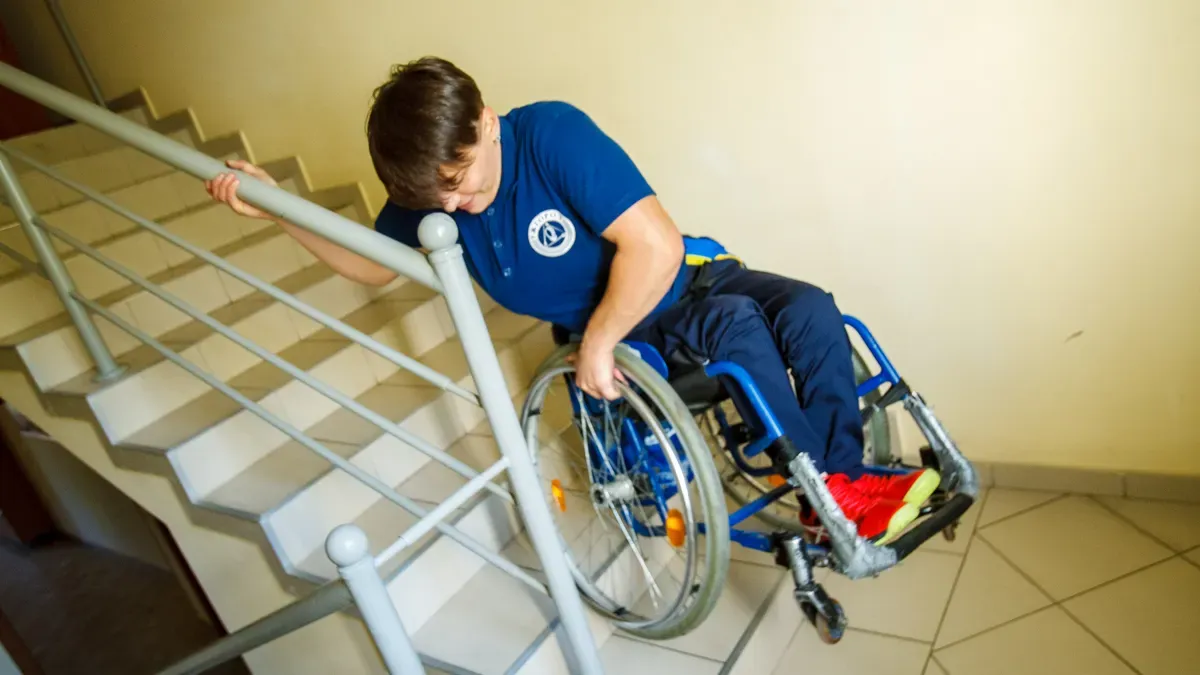
Solo stair for wheelchair navigation is extremely risky and not recommended without proper training and equipment. If you must attempt it, always ensure you have a secure grip, maintain balance, and move slowly. Never rush or skip safety checks.
You should always recognize your limits when facing a stair for wheelchair challenge. If you feel unsure about your ability to navigate stairs safely, ask for assistance. Caregivers, building staff, or trained professionals can provide the support you need. Never hesitate to request help, especially in unfamiliar or crowded environments.
Alert: Your safety comes first. If you feel unsafe or the environment seems hazardous, wait for help rather than risking injury.
By understanding the common barriers, mastering manual techniques, and knowing when to seek assistance, you can approach any stair for wheelchair situation with greater confidence and safety.
When you look for the best stair for wheelchair solution, you encounter a wide range of devices and technologies. Each option offers unique benefits, and the right choice depends on your needs, your environment, and your mobility goals. This section explores the most effective solutions available today.
Wheelchair ramps remain one of the most common and accessible solutions for stair for wheelchair challenges. You can choose from several types; each designed for specific situations. The table below outlines the most widely used ramp types:
Ramp Type | Description |
|---|---|
Portable Ramps | Lightweight and easy to move, ideal for temporary or short-term access. |
Modular Ramps | Prefabricated, customizable sections for permanent yet adaptable use in various settings. |
Threshold Ramps | Low-profile ramps for bridging minor height differences, perfect for doorways and small steps. |
Telescoping or Folding Ramps | Collapsible design for easy storage and transport, popular for vehicle access and travel. |
Most residential ramps support between 600 to 800 pounds, accommodating both you and your mobility device. Portable ramps typically range from 3 to 10 feet in length, making them suitable for a variety of stair heights and entryways. You will find that portable ramps are especially useful if you rent your home or need a temporary solution after an injury. Prices for these ramps range from $100 to $2,000, offering flexibility for different budgets.
Permanent wheelchair ramps, made from materials like wood, aluminum, steel, or concrete, provide stable and reliable access. Installation costs for these ramps usually fall between $800 and $5,500, depending on the materials and complexity.
Tip: Always check the slope ratio of your ramp. A safe ramp should follow the 1:12 rise/run ratio to ensure easy and secure navigation.
If you need a stair for wheelchair solution that does not require manual effort, stairlifts and platform lifts offer advanced accessibility. These devices differ in design and function, so understanding their features helps you make an informed decision.
Feature | Stair Lifts | Platform Lifts |
|---|---|---|
Designed for | Individuals who can sit down | Wheelchair users |
Weight Capacity | Generally lower | Higher, accommodates various sizes |
Safety Barriers | Not typically included | Yes, prevents rolling off |
Emergency Stop Button | Yes, but may vary | Yes, readily accessible |
Non-slip Surface | Not standard | Yes, provides added security |
Regular Maintenance Importance | Essential for safety | Essential for safety |
Stairlifts are suitable if you can transfer from your wheelchair to a seat. They quickly restore access between floors and preserve your home’s layout. Most stairlifts cost between $2,000 and $5,000 for straight models, while custom curved stairlifts can exceed $10,000. Additional features may add $500 to $2,000 to the total cost.
Platform lifts allow you to remain in your wheelchair while moving between floors. These lifts accommodate higher weight capacities and include safety barriers to prevent rolling. Platform lifts are generally more expensive than stairlifts, but they provide a direct solution for users who cannot transfer safely.
Routine maintenance is essential for both stairlifts and platform lifts. Regular checks, professional servicing, and battery replacement every few years ensure reliable and safe operation. You should also budget for potential repair costs and consider a service contract for peace of mind.
Note: Always use seatbelts and safety features when operating lifts. Keep the area clear of obstructions and schedule regular maintenance to maximize safety.
Recent advancements in technology have transformed the stair for wheelchair landscape. Electric stair-climbing wheelchairs and portable stair climbers offer you knew levels of independence and flexibility.
Advancement Type | Description |
|---|---|
Robotic Stabilization Technology | Uses gyroscopes, traction sensors, and AI-driven controllers for smooth navigation on uneven surfaces. |
Battery Innovations | Compact lithium-ion batteries provide lighter frames and longer usage cycles. |
User-Centric Designs | Foldable frames, modular systems, and adaptive controls enhance comfort and usability. |
Semi-Autonomous Navigation | LiDAR sensors and camera-based systems enable potential independent navigation. |
Integration into Public Infrastructure | Piloting stair-climbing wheelchairs in public spaces as part of shared mobility initiatives. |
Electric stair-climbing wheelchairs use track-based systems or articulated wheel clusters to grip and ascend stairs safely. These devices support a wide range of user weights and offer features like automatic balancing, adjustable speeds, and foldable designs for easy storage. You can expect prices to vary based on model, weight capacity, and battery system. Portable stair climbers tend to be more affordable than permanent lift systems and do not require installation.
Pros | Cons |
|---|---|
No permanent installation required | Requires caregiver or attendant assistance |
Easy to transport and store | Battery-powered and needs regular charging |
More affordable than permanent lift systems | Less convenient for daily multi-floor use |
Useful for apartments, travel, emergencies | Some models can be heavy or harder to maneuver on stairs |
You will find these devices especially useful in apartments, during travel, or in emergency situations where permanent solutions are not feasible. Many users appreciate the increased independence and safety these devices provide, allowing them to navigate stairs without extensive home modifications.
Callout: Always assess your specific needs, available space, and safety requirements before choosing a stair for wheelchair device. Consult with professionals or organizations like RESNA for guidance on the best solution for your situation.
By understanding the range of devices and technology options, you can select the stair for wheelchair solution that best fits your lifestyle, enhances your independence, and ensures your safety.
You should always put safety first when choosing stair solutions for wheelchair access.
Evaluate your needs and environment.
Use proper techniques and reliable devices.
Seek professional advice for complex situations.
With the right tools and support, you can make stairs safer and more accessible.
You should choose an electric stair-climbing wheelchair or a platform lift. These devices offer stability, safety features, and reduce physical strain for both you and your caregiver.
You must check the ramp’s length, slope, and weight capacity. Not every staircase supports portable ramps. Always follow manufacturer guidelines for safe use.
You should inspect and service your device every three to six months. Regular maintenance ensures reliable performance and maximizes safety.