Views: 3 Author: Site Editor Publish Time: 2026-11-10 Origin: Site
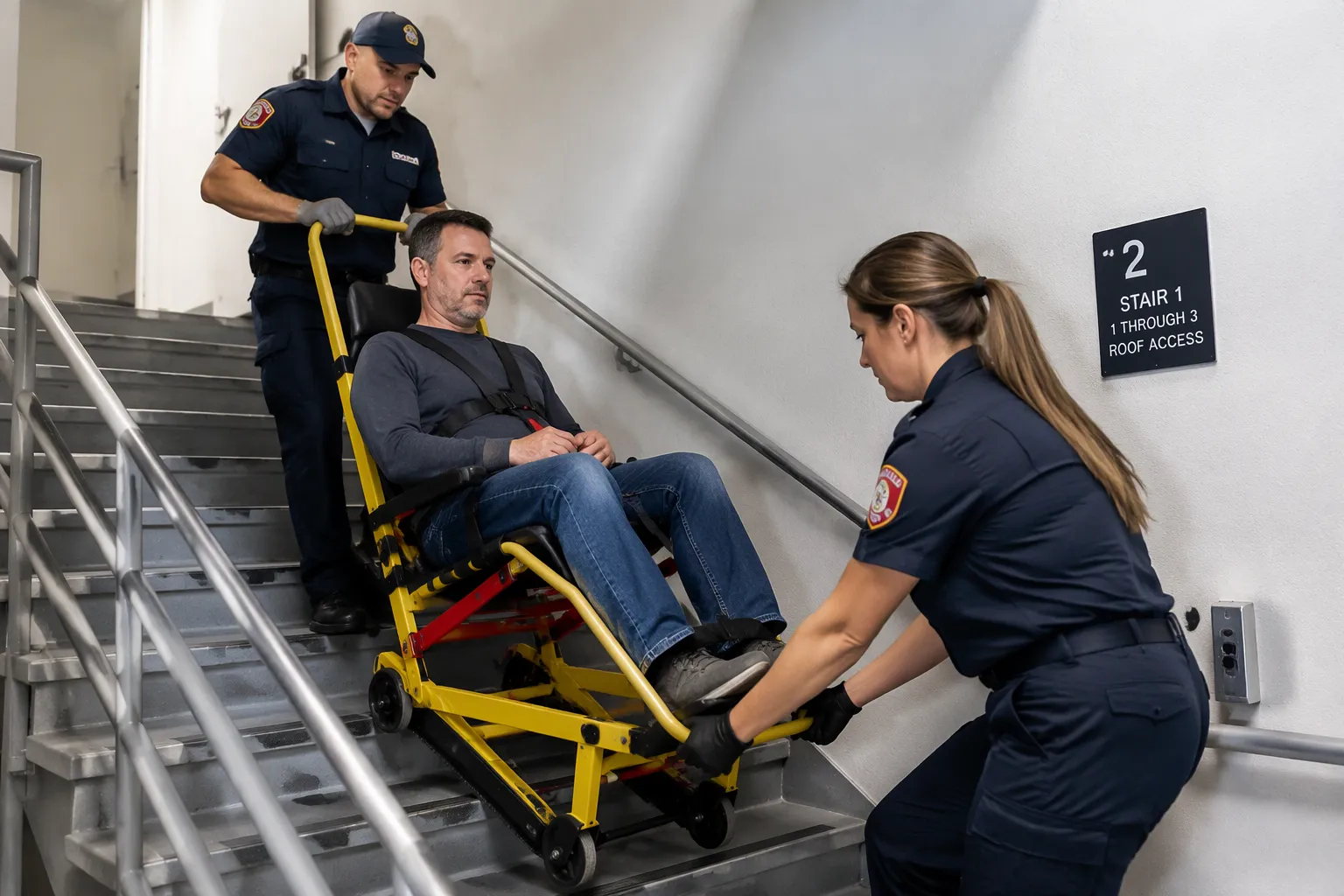
A stair chair stair stretcher is a compact, wheeled device built to move a person down stairs safely during an evacuation. It helps evacuate individuals who cannot use stairs on their own, quickly and with less strain on rescuers. Unlike a standard stretcher for flat ground or a wheelchair that cannot handle steps, this device delivers safer, faster evacuations for people with reduced mobility.
A stair chair stretcher moves people with limited mobility down stairs safely and quickly during emergencies.
Always secure the patient with straps and use trained operators to control the descent step by step.
Inspect the device before every use and perform routine maintenance to ensure it works when needed.
A stair chair stair stretcher is a specialized evacuation device that moves a person over stairs and uneven surfaces with control and stability. It combines a hard frame, a seated platform, and a set of wheels or tracks into one compact unit. The design lets a small team, or even a single trained operator, guide an occupant down a stairwell without lifting the full body weight. Medical Stretchers describes the device as a purpose-built transport tool for stairs and rough ground, with adjustable handles and security straps that protect the patient throughout the descent.
Modern models add features that raise both safety and speed. The StairSafe concept from Ohio State University's design program shows how auto-leveling technology shifts the seat between a flat position for hallways and a chair position for stairwells. That dynamic transition keeps the occupant upright and balanced as the slope changes. Compact frames also navigate tight corners and bends without delay. Storage systems range from wall hooks that hold up to four units to rolling carts that carry eight at once, so facilities can place these devices near the stairwells they serve.
A wheelchair rolls on flat surfaces and depends on the occupant or an assistant to push it. It cannot descend a staircase safely, and its small front casters catch on steps. A standard stretcher provides a flat platform for horizontal transport in ambulances, hospital corridors, and open ground. It offers no built-in mechanism for a controlled vertical drop.
The stair chair stair stretcher fills the gap between these two tools. Its frame stays rigid while tracks or wheels manage the descent, and its harness system holds the occupant in a seated position. Medical Stretchers notes that the hard frame and optional mechanical or electric assistance lower the risk of injury during transport. The table below shows how two representative models translate these design ideas into real specifications.
Model | Key design features | Load capacity | Operation | Other features |
|---|---|---|---|---|
LINE2design Motorized Mobile Stair Chair Lift Climber | Battery-powered track system for smooth and controlled movement up and down stairs | 400 lbs | 2 seconds per stair | Bright yellow color enhances visibility; easily foldable for storage |
LINE2design Motorized Mobile Stair Lift Climber | Power track system that eliminates the need to lift, offering controlled movement on stairs and enhanced stability | 440 lbs | Battery lasts for 2500 stairs on a full charge | Foldable design, adjustable head support, sturdy construction |
Buyers also choose between manual and powered options. Medical Stretchers lists battery evacuation stair chairs, manual evacuation stair chairs, and hybrid units such as the MOBI EZ Power Stair Chair, which pairs a powered wheelchair with a stair chair function. Track-based systems from Stryker and Ferno carry the weight of the patient so a single operator can manage the descent. These variations let a facility match the equipment to its staffing levels and building layout.
A stair chair stair stretcher serves anyone who cannot descend stairs quickly and safely under emergency conditions. Evacuscape groups these individuals into several clear categories. The list below covers the most common cases.
Seniors, whose mobility challenges become more common with age and who often need assistance on stairs.
Pregnant women, whose balance, lung capacity, and stamina change during pregnancy and who face added hazard under stress.
People with mobility impairments, including muscle weakness, spasticity, or fatigue.
People who rely on mobility tools such as wheelchairs, walkers, crutches, or canes.
Injured occupants with sprains, fractures, surgical recovery, or severe pain.
People with cardiac or respiratory conditions such as asthma, COPD, or heart disease that limit exertion.
Evacuscape also uses the term Person with Reduced Mobility, or PRM, to describe someone who struggles to move quickly or confidently because of physical or mental limitations. These limitations may be permanent, temporary, minor, or serious. Some are invisible. A PRM may handle stairs on a normal day and still need extra time during an emergency. A stair chair stair stretcher removes that time pressure and gives trained helpers a controlled way to move the person to safety.
Facilities store stair chair stretchers wherever stairs create a bottleneck during an evacuation. High-rise office buildings, hospitals, schools, and hotels place them near stairwells and elevator lobbies. Medical Ride reports common use in split-level homes and porch steps after a hospital discharge, walk-up apartments without elevators, and short interior stairs in skilled nursing facilities and hospitals. The compact, foldable design of most models supports this placement strategy. Units fold flat for storage in closets, on wall hooks, or on rolling carts, so they stay close to the routes they protect.
A stair chair stair stretcher combines a rigid frame, a seated platform, and a stair-engagement system into one transport tool. The frame carries the occupant's weight. The stair-engagement system controls the descent. The operator guides the device instead of carrying the full load. Medical Stretchers explains that an evacuation chair allows responders to guide a patient down step by step without lifting the full body weight. Many models use track systems or friction belts that grip the stairs during movement. That design turns a dangerous manual carry into a controlled, guided descent.
The construction materials matter just as much as the mechanism. Medical Stretchers lists the core features of a well-built evacuation stair stretcher:
High-strength aluminum alloy frame materials
Two stationary rear wheels that move the patient over most surfaces with minimal effort
Three patient restraint straps with quick-release buckles
Two flexible uplift rods under the front of the stretcher
A folding design that tucks easily into an ambulance
A lightweight, small-sized body with fluid-resistant materials for easy sterilization and cleaning
Patient security depends on a robust harness system. LINE2EMS notes that a strong harness straps the user in and prevents falls. Effective brakes control the descent on stairs. Anti-tip mechanisms and sturdy construction materials add further protection. Comfort features matter too. A cushioned seat minimizes discomfort during transfers. Ergonomically designed handles and controls reduce physical strain on the operator. Adjustments for different body types and sizes extend comfort to a wide range of users.
Medical Stretchers summarizes the practical benefits of these design choices in four points:
Comfort: the padded seat supports the occupant during transport.
Stability: the design provides a stable base for patients.
Ease of use: caregivers can navigate stairs with the tool without special effort.
Lightweight build: the light frame allows easier handling.
These features work together. The frame and tracks control the descent. The straps and harness hold the occupant in place. The padding and adjustable handles protect both the patient and the operator. A facility that selects a stair chair stair stretcher with all of these elements gains a tool that performs reliably under pressure.
A stair chair stretcher fits specific evacuation conditions. It does not replace every transport method. Evacuation Slyde compares evacuation chairs with medical sleds across several criteria, and the table below summarizes the key differences.
Criterion | Evacuation Chair | Medical Sled |
|---|---|---|
Patient consciousness and cooperation | Adequate for conscious, cooperative individuals; may not suit an unconscious person who cannot stay upright and balanced | Transports any individual, even when unconscious or badly injured; straps hold the person in place |
Operator training | Requires substantial training and practice; untrained operators cannot manage a patient heavier than themselves | Two to seven individuals can use it safely with little to no training |
Weight and strength | Cannot be used if the patient is heavier than the chair operator without proper training | Two to seven operators guide it down stairs |
Setting and accessibility | Standard resource for hospitals and medical facilities; someone must bring the chair to the individual; heavy | Pulls rather than lifts non-ambulatory patients down stairways and across obstacles; needs two or more staff |
Staff ratio | Convenient 1:1 ratio of user to transportee | Two to seven operators |
Evacuation Slyde also offers guidance on matching the device to the situation:
Carry devices, such as those used by firefighters, should stay reserved for highly trained staff. Asking staff to lift and carry patients in an emergency can lead to injuries.
Rolling equipment such as evacuation chairs works as a customized wheelchair for descending stairs. Elevators cannot be counted on during an emergency, so standard wheelchairs serve as evacuation devices only on ground-level floors.
Medical evacuation sleds pull non-ambulatory patients down stairways and across hallways and obstacles.
Rolling devices offer an excellent staff-to-patient ratio but struggle over obstacles. A medical sled handles obstacles well but requires two or more staff. An evacuation chair may be convenient but less accessible than a wall-mounted sled, depending on the situation.
The MSE Company adds a facility-level view. Retirement and care facilities need evacuation chairs that meet the requirements of both their patients and the environment. The device must maneuver the specific stairwell design. It must stay light and easy for one individual to handle, even when more than one patient uses it. Facilities should test various models before purchasing one for emergency use.
Operators should reach for a stair chair stretcher in several common scenarios. A conscious patient who can sit upright and follow simple instructions is an ideal candidate. A building with a working stairwell and a trained response team supports chair-based evacuation. A patient who weighs less than the trained operator, or a team with proper training, can manage the descent safely. When the patient is unconscious, badly injured, or heavier than the available operators can control, a sled or a multi-person carry team may serve better. The right choice depends on the patient, the building, and the training of the responders.
A safe evacuation follows a defined sequence. Delta Medical Transportation describes the process in four stages. The crew first assesses the staircase. Before anyone moves, the team walks the route and checks the width of the stairs, the landings and turns, the railing, the lighting, and the vehicle position outside. They plan the descent before it starts. The crew then transfers and secures the patient. They help the patient from the bed or chair into the stair chair, secure the chest and lap straps, and position the feet and arms inside the frame. Nothing moves until the patient is fully secured. The team then performs a slow, controlled descent. One crew member stands above the chair and one below. The chair comes down one step at a time. The patient stays seated and strapped the entire way and never bears weight, balances, or grabs a railing. At street level, the crew transfers the patient from the stair chair into a wheelchair or onto a stretcher and secures the patient in the vehicle.
MedicTests adds operational detail for multi-person teams. The designated team leader gives the verbal order to begin the carry. The team moves one step at a time. Special attention goes to stairs during or immediately after bad weather, which raises the risk of slips. Once the patient and all team members reach the bottom, the team slowly lowers the stair chair to the ground while keeping heads up and backs straight. The lead professional then rolls the device as a wheelchair to the transfer point, where the patient moves to the waiting stretcher.
The full sequence follows this order:
Assess the stairwell, landings, lighting, and exterior vehicle position.
Transfer the patient into the chair and fasten all restraint straps.
Confirm that feet and arms sit inside the frame.
Assign one operator above the chair and one below.
Give the verbal order and descend one step at a time.
Lower the chair at the bottom with proper body mechanics.
Roll the patient to the transfer point and move them onto the stretcher.
Each step protects the patient and the team. The pre-walk prevents surprises on the route. The strap check prevents falls. The two-operator position distributes control. The slow descent keeps momentum in check. The final transfer returns the patient to a standard transport platform for the ride to safety.
A stair chair stair stretcher must pass inspection before every evacuation. Everisemed outlines a six-part check that covers the whole device. The operator starts with a visual inspection. The frame should show no cracks, bends, or corrosion. Wheels should spin freely without wobbling or binding, and treads should show no wear that reduces traction. Safety straps should show no fraying, cuts, or weak points, and buckles should fasten and unfasten smoothly. The operator then tests the stair-climbing mechanism. At the bottom of a set of stairs, the track or crawler system should align properly with no loose parts. A manual test up a couple of steps should feel smooth and consistent with no jerking. A wheel-based system should transition from step to step without sticking.
Stability testing comes next. The operator places a weight that mimics an average patient, such as sandbags, on the stretcher and pushes and pulls it gently from different angles. The device should not tilt or become unsteady. Locks should hold firmly and release easily after several engage-and-release cycles. The operator then checks mobility on flat surfaces. The stretcher should steer easily across a smooth floor, and the handle grip should feel comfortable. The brakes should stop the device quickly and release for free movement. Patient comfort and attachment follow. Padding should feel thick enough for comfort and still retain support. The restraint system, headrest, and side supports should adjust and secure properly. The final check covers accessories. IV poles and oxygen tank holders should attach and detach easily with strong, secure connections that do not interfere with normal operation.
Routine maintenance keeps the device ready between inspections. LINE2EMS recommends a simple schedule:
Clean regularly: wipe down the seat, handles, and wheels after each use with suitable cleaners.
Inspect regularly: check for loose bolts, frayed straps, and malfunctioning brakes, and repair issues promptly.
Lubricate moving parts: keep wheels and joints lubricated for smooth operation.
Store properly: keep the chair in a clean, dry area to prevent rust and deterioration.
Check battery life: for motorized chairs, verify the battery and charging system regularly.
A stair chair stretcher that fails a safety check should come out of service immediately. A backup unit and a documented inspection log keep the evacuation plan intact.
These checks take only a few minutes. They confirm that the frame, straps, brakes, and tracks will perform when the stairwell fills with smoke or the power fails. A facility that builds these checks into its routine protects every occupant who depends on the device.
A stair chair stretcher anchors any evacuation plan for people with reduced mobility. The right equipment and proper training let speed and safety work together. Facility managers should review their evacuation plans, confirm they have the right equipment, and train staff or caregivers before an emergency happens.
Most manual models need two trained operators for a controlled descent. Powered track systems let one trained operator manage the descent alone. Facilities should confirm staffing levels before selecting a model.
A stair chair stretcher suits conscious patients who can sit upright and follow instructions. Unconscious or badly injured patients need a basket stretcher or evacuation sled instead. Responders should match the device to the patient's condition.
Operators should inspect the device before every use. Facilities should also schedule routine maintenance checks and keep a documented inspection log. A unit that fails any check should leave service immediately.
Avoid Making Incorrect Aluminum Casting Process Choices Ever Again