Views: 2 Author: Site Editor Publish Time: 2026-11-09 Origin: Site
Choosing an evacuation chair manufacturer in 2026 comes down to four tests: defined building and occupant requirements, verified technical performance and compliance, application fit and total cost, and dependable training and support. A manufacturer's certifications, documentation, and service capability carry as much weight as the chair itself. The National Building Construction Standards 2026 replaced NBC 2016 on April 30, 2026, so buyers must verify current compliance with an evacuation chair manufacturer rather than assume it.
Define your building's needs and occupant profiles before you contact any manufacturer.
Verify every safety certificate and test report against current 2026 standards.
Compare total lifetime costs and support services, not just the unit price.
A clear requirements brief saves time and money. Buyers who document their building and occupants first can compare manufacturers on equal terms.
Measure every stairway width, landing depth, and door clearance along each evacuation route. Note turns, handrail positions, and surface materials. These physical details determine which chair types can travel the route safely and quickly. Photograph each route and record the measurements in a shared file.
Safety-chair.com recommends identifying evacuation routes first and checking for features that may limit timely chair evacuation. The same source advises building a Personal Emergency Evacuation Plan (PEEP) for anyone who will definitely need assistance. That plan should account for the individual and the surrounding building. Safety-chair.com also suggests including PEEP participants in the safety assessment process and demonstrating the chair on site with the individual involved. A live demonstration builds confidence for both passenger and operator. Site assessments and demonstrations show whether the proposed equipment is feasible.
Translate the survey and occupant profiles into a written specification. State the required load rating, descent control type, chair weight, folded dimensions, and operating temperature range. Add any code-driven requirements from the 2026 editions. A written specification gives every manufacturer the same target and makes later scoring objective.
Specifications on a brochure page tell only part of the story. A careful buyer tests every claim against current documentation, independent test data, and the code editions that govern the building in 2026. This stage separates manufacturers who publish verifiable data from those who rely on marketing language.
Ask each evacuation chair manufacturer for a complete certificate package, not a single logo on a datasheet. The package should include the certificate number, the issuing body, the standard edition tested against, and the expiry date. Cross-check each certificate against the issuing body's public register. A certificate that cannot be verified in a public database deserves scrutiny.
Standards move on a multi-year cycle. A certificate issued against a superseded edition may no longer satisfy an authority having jurisdiction. Confirm that the test standard cited on the certificate matches the edition referenced in the local code. Request the declaration of conformity and the test report summary in the same request. Manufacturers who supply these documents quickly usually maintain better records overall.
Product registration adds another layer of assurance. Evacuscape states that its chairs are CE certified and registered with the FDA, and that the range supports ADA and AODA accessibility planning across multi-story portfolios. Registration with a regulator does not replace building code approval, but it shows a manufacturer that invests in formal market access. Buyers should treat registration as one data point among several.
Load rating is the first number most buyers check, and it is also the number most often misread. A rated capacity describes a tested limit under defined conditions. Ask for the test method behind the figure, the safety factor applied, and the conditions of the test. A chair rated for a heavy occupant should carry documented evidence of that performance, not a rounded claim.
Compare ratings across candidates on the same basis. Some manufacturers publish a working load, others publish a maximum tested load, and a few publish both. Normalize the figures before ranking them. Add a margin above the heaviest expected occupant to account for clothing, equipment, and dynamic loads during descent.
Stability matters as much as capacity. Request data on tip resistance, harness anchorage strength, and performance on wet or uneven stair surfaces. Evacuscape reports that its models support occupants weighing up to 180 kg (400 lbs) with secure harnesses and durable rubber tracks. Garaventa reports that the Evacu-Trac carries up to 300 lbs. These figures help buyers match a chair to the occupant profile established in the requirements brief.
Descent control is the heart of an evacuation chair. The track, brake, and control system determine whether one operator can move a passenger down a stairwell safely. Ask each manufacturer to demonstrate the full descent sequence on a representative staircase. Watch how the chair behaves at the top landing, mid-flight, and at the bottom.
Friction track systems use the passenger's weight to drive descent while the track controls speed. Evac+Chair describes its Evac+Track technology as self-braking reinforced tracks that control descent speed for easy single-person operation. The same source notes lockable rear wheels for stationary positioning and heavy-duty wheels for uneven terrain. These features matter in buildings with mixed floor surfaces and tight landings.
Brake architecture varies by model, and the differences affect operator confidence. Evacuscape describes two approaches in its range. The EC1 uses a speed-reducing V-belt track for controlled stair descent and a 5-point harness with head restraint. The EC2 uses a fail-safe braking system for maximum descent control and adds an emergency under-seat LED light for visibility. Garaventa explains that the Evacu-Trac brake is normally on, and the operator releases it by slowly squeezing the brake lever. A governor limits maximum descent speed to about 3 feet per second, which allows even a small attendant to transport heavier wheelchair users. The tracks grip stair noses regardless of the stair covering, and a fail-safe brake brings the unit to a complete stop automatically.
Buyers should test three things during a demonstration. First, confirm that the brake engages when the operator releases the lever. Second, confirm that descent speed stays stable on the steepest stair in the building. Third, confirm that one trained operator can manage the chair without a second person on the stairs. A chair that needs two operators changes the staffing plan for every floor.
Code alignment is a moving target in 2026. The National Building Construction Standards 2026 replaced NBC 2016 on April 30, 2026, and local amendments may add further requirements. Buyers should confirm alignment against the edition enforced in their jurisdiction, not against a generic claim of compliance.
ADA obligations extend beyond doorways and ramps. Public universities hold duties under ADA Title II and Section 504 to make emergency evacuation accessible, according to Outpost Evacuation. NFPA 101 and the California Fire Code expect a means of egress for everyone. The Clery Act requires testing and disclosure of emergency procedures, and insurers increasingly ask for documented evacuation capability at renewal. Elevators recall and leave service the moment an alarm sounds, so stairs become the only route for many occupants.
Building features interact with chair selection. Lift-Aids notes that multi-story buildings without full elevator emergency-power override often require designated areas of refuge with two-way communication. The same source states that ADA-compliant plans call for audible alarms and visual strobe notifications, clear signage to accessible egress routes, and designated staff evacuation assistants per floor with hands-on chair training and at least one real drill each year. Residence halls are one of the few high-rise occupancies where the code does not require an area of refuge at the stairs, according to Outpost Evacuation, which makes a portable chair program the practical fallback. In 2024 the University of California directed all ten of its campuses to provide evacuation chairs and individualized evacuation plans.
Documentation closes the loop. An inspection checklist from Oxmaint includes a compliance item confirming that the chair meets current ADA requirements, and the checklist aligns with ADA requirements, NFPA evacuation standards, OSHA regulations, and manufacturer specifications. Buyers can adopt a similar checklist and attach it to each unit's maintenance record. That record supports audits, insurance reviews, and future procurement decisions.
A chair that passes every technical test can still fail in daily use. Application fit decides whether the equipment works on the actual stairs, fits the actual storage space, and reaches the landing before the stairwell fills with smoke. Total cost decides whether the program survives budget review in year one and year five. Buyers should score both dimensions with the same rigor they applied to compliance.
Stair geometry drives chair selection more than any other factor. Evacuscape notes that staircase width, landing size, number of floors, and corridor spacing all influence how effective a chair will be in practice. The same source warns that a model which works seamlessly in a wide, modern stairwell may struggle in a tighter or older layout. A chair with a wide track base and long wheelbase suits a straight, generous flight. A compact model with a narrow profile suits a switchback stair in an older building.
Buyers should walk each route with the candidate chair in mind. Measure the narrowest point between handrails. Check the turning radius at every landing. Confirm that the chair can pivot at the mid-flight landing without lifting. Test the chair on the steepest flight in the building, because descent speed and operator control change with pitch. A demonstration on a flat floor proves very little.
Chair type also follows the staffing model. A one-operator chair with governed descent suits buildings where a single trained staff member covers a floor. A two-operator model may suit a facility with larger response teams. The choice affects the PEEP for every occupant who needs assistance, so the safety officer and the facilities team should agree on the operating model before the purchase order.
Storage and deployment decide how fast a chair reaches the stairwell in a real alarm. Evacuscape lists three considerations that shape this decision.
Consideration | Detail |
|---|---|
Storage design | A compact, foldable design allows for quick access without obstructing pathways. Emergency equipment must perform consistently, even after long periods of storage. |
Building layout compatibility | Staircase width, landing size, number of floors, and corridor spacing all influence how effective a chair will be in practice. A model that works seamlessly in a wide, modern stairwell may struggle in a tighter or older layout. |
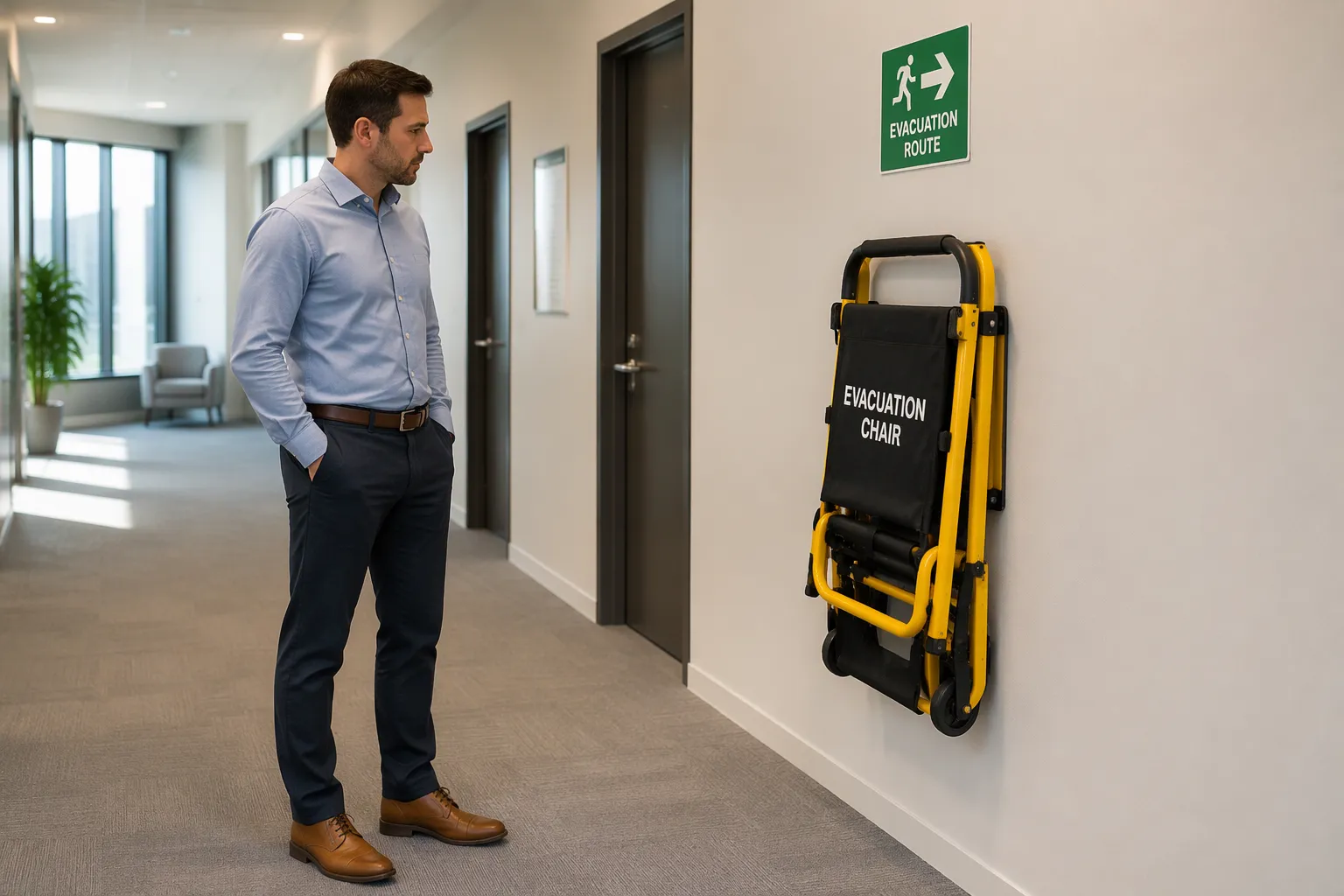
Placement | Government of Canada emergency planning resources recommend placing evacuation equipment such as chairs near stairwells, ensuring they are accessible and ready for immediate use when elevators are unavailable. |
Placement practice in real facilities follows that guidance. Lane Community College stores all of its evacuation chairs in wall-mounted storage cabinets located directly adjacent to primary escape stairwells. The college also requires a full battery recharge every three months for any unit kept in storage. Buyers should copy this discipline into their own maintenance calendar. A chair that sits untouched for a year may not deploy when needed.
Deployment skill comes from practice, not from reading a manual. Evac+Chair describes a training progression that starts with opening and closing the chair and practicing deployment without a passenger. Trainees then progress to increased weight such as a mannequin, and finish by handling a real person in a controlled environment. In-person training also helps operators learn to navigate real-life building layouts, including tight stairwells, sharp corners, or unexpected obstacles. Buyers should ask each evacuation chair manufacturer whether the training covers the buyer's own stairwells or only a generic classroom layout.
Unit price is the smallest number in the budget. Evacplan Generator reports that modern evacuation chairs run $1,500 to $5,000 each, and multi-chair facility programs require significant budgeting. That range covers hardware only. Training, inspection, replacement parts, and staff time add to the figure over the life of the equipment.
Training carries a predictable cost. Evacplan Generator describes an initial hands-on session with the manufacturer's representative or a certified trainer, typically two hours. Annual refresher sessions run 30 to 60 minutes and repeat the key techniques with practice descents on the actual building stairs. Some models are intuitive enough for one-time training, while others require initial training plus annual refreshers. Staff turnover rate should shape this choice, because every new hire needs the same instruction.
Maintenance and parts form the second cost layer. Evacplan Generator notes that chairs require periodic inspection of tracks, brakes, and frame, and it advises buyers to select a model with available local service. Powered stair-climbing chairs reduce operator effort substantially and can be operated by a single person. Their downsides include battery life of typically two to three descents per charge, weight of often 50 to 80 lb empty, and a cost of $5,000 to $15,000. Buyers should weigh those trade-offs against the staffing plan rather than against the sticker price alone.
Warranty terms reveal how a manufacturer treats the long tail of ownership. Evac+Chair publishes a lifetime product warranty for the original purchaser, and the terms show where costs can still land.
The lifetime warranty covers manufacturing defects that affect reasonable operation of the chair.
Warranty claims exclude expendable parts, which carry a two-year coverage period. Expendable parts are those routinely replaced during inspection, repair, or maintenance.
The manufacturer reserves the right to have the original purchaser return parts or products at their cost for warranty claim evaluation.
A claim found not to be a manufacturing defect entitles the manufacturer to charge the customer in full for repair or maintenance.
All warranty claims must be made by the original purchaser in writing within seven days of discovering the basis for the claim.
Buyers should read every candidate's warranty against this level of detail. A warranty that names the covered parts, the claim window, and the return process gives the facilities team a workable plan. A warranty that offers only a duration gives them a hope.
Pricing transparency helps the comparison. Evacuscape lists its EC2 enhanced safety model with fail-safe braking at $1,995.00, and it states that the price includes free online training and lifetime support. Buyers can use published prices and included services to build a five-year cost model for each candidate. The model should total hardware, initial training, annual refreshers, expendable parts, inspection labor, and expected replacement year. The lowest five-year total often belongs to a mid-priced chair with strong local support, not to the cheapest unit on the quote sheet.
Training, maintenance, and support determine whether a chair program works after the purchase order clears. Buyers should score each evacuation chair manufacturer on these three services with the same rigor applied to hardware.
A strong training program combines theory with hands-on practice. CPL Institute structures its evacuation chair course around legislation, musculoskeletal issues, ergonomics, risk assessment, and the eight principles of safe manual handling, and it closes with practical exercises on getting a person onto the chair and maneuvering down stairs.
Course Objectives | Course Subjects |
|---|---|
Describe the main aspects of Legislation | Legislation |
Understand the issues to consider when using an evacuation chair | The Musculoskeletal System |
Apply the 8 principles of Safe Manual Handling when using the chair | Ergonomics, Risk Assessment and Principles of Safe Manual Handling |
Adopt good working posture | Evacuation |
Get the person onto the chair | Practical Exercise |
Maneuver the chair down stairs in a safe manner |
|
Evac+Chair advises buyers to confirm that employees receive comprehensive theoretical and practical instruction from a fully qualified trainer. Evacuscape recommends training all team members to prevent confusion during an emergency, hosting demonstrations, and using the informational DVD that ships with each chair.
A written schedule keeps equipment ready. Vingrace outlines a practical cadence.
Task | How often | Who |
|---|---|---|
Visual check | Monthly | Trained in-house staff |
User function check and cleaning | Every 3 months | Trained in-house staff |
Battery check (powered chairs) | Monthly, or as per maker | Trained in-house staff |
Full service | At least once a year | Maker or authorized technician |
Operator refresher training | Every 6 to 12 months | Trainer or supplier |
Check after use or drill | Every time | Operator |
Parts access matters as much as the schedule. The International Fire and Safety Journal notes that some manufacturers do not supply genuine parts to third parties, which limits outside technicians to visual inspection only. Buyers should confirm that local service partners can obtain genuine tracks, straps, belts, and batteries.
Warranty length alone does not prove compliance. Mark Wallace of Evac+Chair International warns:
"It is an increasingly common misconception that purchasing an emergency evacuation chair with a long product warranty is enough to comply with health and safety regulations."
Evacusafe offers a standard 15-year warranty against manufacturing defects and normally ships a replacement while collecting the faulty unit, so a site is never left uncovered. Evacuscape states that its chairs carry a lifetime manufacturer's warranty with responsive customer service. Xieeh advises buyers to weigh long-term maintenance and warranty costs and to assess supplier responsiveness from first inquiry through after-sales support.
A sound choice balances four elements: defined requirements, verified 2026 compliance, application fit, and long-term support. Buyers should score every candidate against the same criteria. They should also confirm references and arrange site visits before deciding. Documenting the evaluation supports compliance audits and future reviews.
Count the occupants who need assistance on each floor. Place at least one chair near every primary stairwell. Confirm the total against the local code and the PEEP.
Many models allow single-operator descent with governed braking. The operator needs training and practice on the actual stairs. Two-operator models suit larger response teams.
Annual refreshers keep skills current. High turnover demands more frequent sessions. New hires need instruction before they join an evacuation team.
Avoid Making The Wrong Aluminum Casting Process Choice Ever Again